
A Black Labrador named Sgiath has been named Animal of the Year for helping protect marine wildlife by sniffing out an invasive creature known as “sea vomit.” The six-year-old dog from the Scottish Highlands has an extraordinary talent that could change how conservationists detect harmful species hiding along coastlines and in harbors.
Working alongside her human, marine ecologist Dr. Texa Sim, Sgiath uses her powerful nose to locate carpet sea squirt, an invasive organism that can spread rapidly and threaten native marine life. Her remarkable work earned her international recognition at the International Fund for Animal Welfare’s Animal Action Awards in London on October 15, 2026.
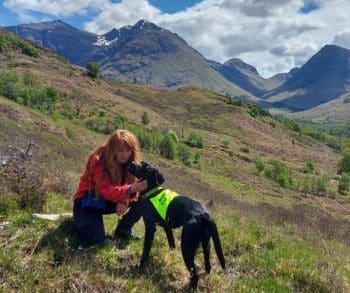
From Mountain Rescue Training to Marine Conservation
Before becoming a marine conservation dog, Sgiath trained for mountain rescue searches. Her background gave her valuable scent-detection experience, but her next assignment would be quite different from searching for people in the mountains.
Sim recognized that dogs trained to locate scents could potentially help scientists detect invasive marine organisms. Detection dogs already assist conservation efforts on land, but using their noses to identify species in marine environments offered an exciting new possibility.
She began training Sgiath to recognize the scent of carpet sea squirt, an organism that can be difficult to distinguish from other marine growth. According to IFAW, Sgiath is believed to be the first dog in the world trained specifically to detect this invasive species.
The moment that convinced Sim that the training might succeed came during an early scent-identification exercise. Sgiath was presented with several similar smells and asked to locate the target organism.
“The first time I asked her to identify the target species among lots of similar scents, she went straight to it,” Sim recalled. That successful identification gave the marine ecologist confidence that her unusual approach could work.
Why Finding Sea Vomit Matters
Carpet sea squirt has earned the unpleasant nickname “sea vomit” because of its slimy appearance. It can grow over seaweed and attach itself to structures such as pontoons and oyster cages, making early detection especially challenging.
The invasive organism can spread across harbor environments and smother native marine wildlife. It is believed to have originated in Japan and was first recorded along shorelines in England and Wales in 2008.
Identifying the organism traditionally involves specialist laboratory analysis and DNA testing. Sgiath offers another way to search for its presence by recognizing its distinctive scent.
Her work could help conservationists identify potential infestations more efficiently and determine where further investigation is needed. Rather than relying entirely on visual searches, researchers can explore whether trained dogs can assist with early detection.
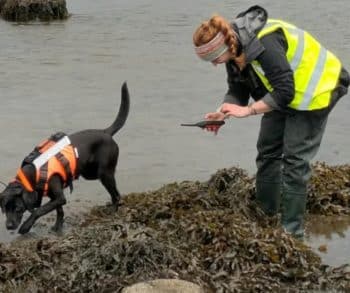
A Clever Labrador With a Very Simple Motivation
Despite the scientific importance of her work, Sgiath has a wonderfully ordinary motivation for doing such an extraordinary job. According to IFAW, her favorite reward for successfully finding the target scent is food.
Sim affectionately describes her talented Labrador as a “greedy dog.” That enthusiasm for treats has become part of a training partnership that could make a meaningful contribution to marine conservation.
And Sgiath may soon have some company on her unusual assignments. Sim is training another Labrador, three-year-old Uisge, to help with the same type of detection work.
The experience has also deepened Sim’s appreciation for what dogs can accomplish. She told IFAW that the animals continue to surprise her with their ability to recognize incredibly faint concentrations of scent, often exceeding what she previously believed possible.
Sgiath Receives a Well-Deserved Honor
On October 15, Sgiath’s work received special recognition when IFAW honored her as Animal of the Year at its Animal Action Awards ceremony in London. The award celebrated her contribution to an innovative approach to protecting marine ecosystems.
For Sim, the recognition was unexpected. She explained that her motivation has always been her love of working with dogs, learning from them, and exploring ways they can support conservation.

She described having that work recognized as humbling, particularly because the project began with an idea about what a dog’s nose might accomplish in underwater conservation efforts.
Now, with Sgiath already demonstrating her remarkable detection skills and Uisge learning to follow her example, the project continues to explore new possibilities. For one food-loving Black Labrador from the Scottish Highlands, sniffing out an unusual marine creature has become an award-winning job.
This content was created with AI assistance and edited by the iHeartDogs team.
 Toledo, United States.