
You walk into the room only to find your favorite sneakers shredded across the floor, the laces in one corner, and the soles in another. It’s a frustrating (and surprisingly common) problem for dog parents. But before you assume your dog is being spiteful, it’s important to know that dogs don’t chew shoes out of revenge. In fact, there are several perfectly natural reasons why your footwear is so irresistible.
From fascinating scents to satisfying textures, your shoes appeal to many of your dog’s strongest instincts. Understanding why dogs chew shoes can help you redirect the behavior before your next favorite pair becomes a casualty.
Chewing Is Perfectly Normal Dog Behavior
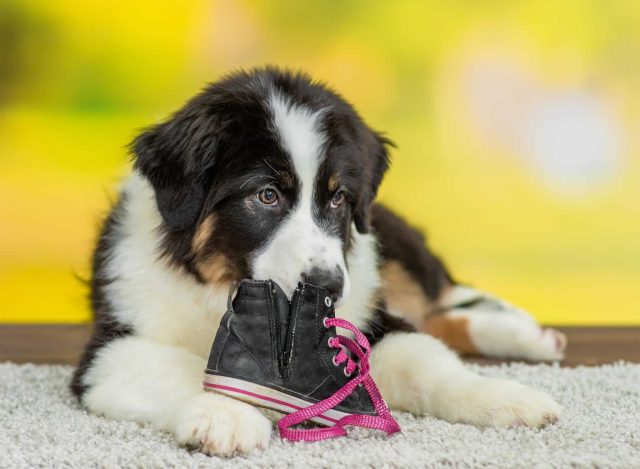
Chewing is an instinctive behavior that begins in puppyhood and often continues into adulthood. Puppies chew to relieve the discomfort of teething and to explore the world around them. Adult dogs chew to exercise their jaws, keep themselves occupied, relieve stress, and satisfy natural foraging instincts.
Dogs evolved as opportunistic scavengers, meaning they learned to investigate and make use of almost anything that might provide food or enrichment. That’s one reason many dogs happily chew on things humans consider garbage—from sticks and cardboard to, unfortunately, your expensive shoes.
The goal isn’t to eliminate chewing altogether—it’s to give your dog appropriate outlets for this completely normal behavior.
Your Shoes Are a Sensory Gold Mine
One of the biggest reasons dogs love shoes is that they provide an incredible sensory experience.
A dog’s sense of smell is estimated to be 10,000 to 100,000 times more sensitive than ours, allowing them to detect layers of scent that humans can’t even imagine. To your dog, your shoes tell the story of your entire day.
They smell like:
- You
- Your feet and natural body oils
- The places you’ve walked
- Grass, dirt, leaves, and other animals
- Food particles
- Other people and pets you’ve encountered
To us, shoes are just footwear. To your dog, they’re a fascinating collection of scents worth investigating.
Many dogs also find human scent comforting. If you’ve been away at work all day, your shoes may become a stand-in for your presence, especially for dogs that are particularly bonded to their owners.
The Texture Is Just as Appealing
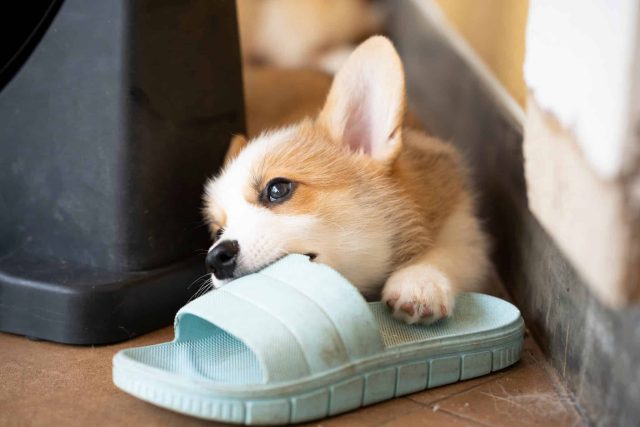
Dogs don’t just explore with their noses; they also investigate with their mouths.
Shoes offer a variety of textures that make chewing especially rewarding:
- Soft fabric uppers
- Tough leather
- Flexible rubber soles
- Foam cushioning
- Dangling laces
- Stitching that can be pulled apart
Leather shoes can be particularly attractive because leather retains some of the scent of the animal hide it originated from, much like rawhide chews. Combined with your familiar scent, leather shoes can seem like the perfect chew toy from your dog’s perspective.
Chewing Can Actually Feel Good
Chewing isn’t just entertaining—it may also help dogs feel calmer.
Research suggests that repetitive chewing activates reward pathways in the brain, including the release of dopamine, a neurotransmitter associated with pleasure, motivation, and emotional well-being. The rhythmic action of chewing may also help reduce stress and promote relaxation in some dogs.
That’s one reason many dogs chew after exciting events, during thunderstorms, or when left home alone. For anxious dogs, chewing can become a form of self-soothing.
Boredom Is Another Common Culprit
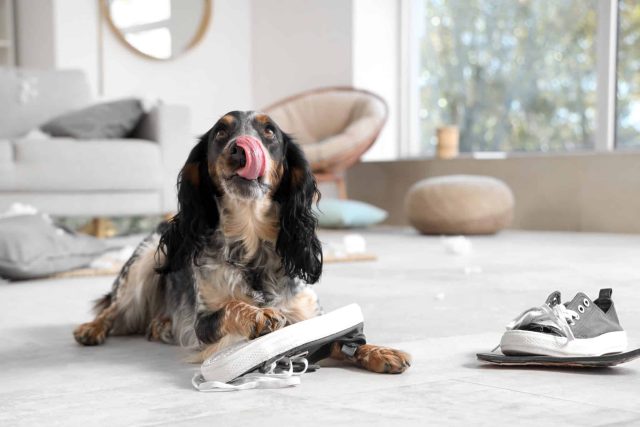
Dogs need regular mental and physical stimulation. If they don’t have enough appropriate activities, they’ll often create their own entertainment.
Unfortunately, your shoes are conveniently located, smell amazing, and are much more interesting than an untouched chew toy sitting in the corner.
Dogs are especially likely to target shoes if they:
- Spend long periods home alone
- Don’t receive enough daily exercise
- Need more mental enrichment
- Lack appropriate chew toys
- Are high-energy working or sporting breeds
Food puzzles, sniffing games, training sessions, and durable chew toys can all help satisfy your dog’s need for enrichment.
Could It Be Separation Anxiety?
Sometimes shoe chewing goes beyond simple curiosity or boredom.
Dogs with separation anxiety often seek out objects carrying their owner’s scent, including shoes, socks, blankets, or clothing. They may chew these items while experiencing significant emotional distress during your absence.
If your dog also exhibits any of these behaviors when left alone, separation anxiety may be involved:
- Excessive barking or whining
- Destructive behavior focused near doors or windows
- House-soiling despite being house-trained
- Excessive drooling or panting
- Attempts to escape
- Refusing food when alone
Because separation anxiety is a medical and behavioral condition, it’s best evaluated by your veterinarian or a qualified veterinary behaviorist.
How to Stop Your Dog From Chewing Shoes
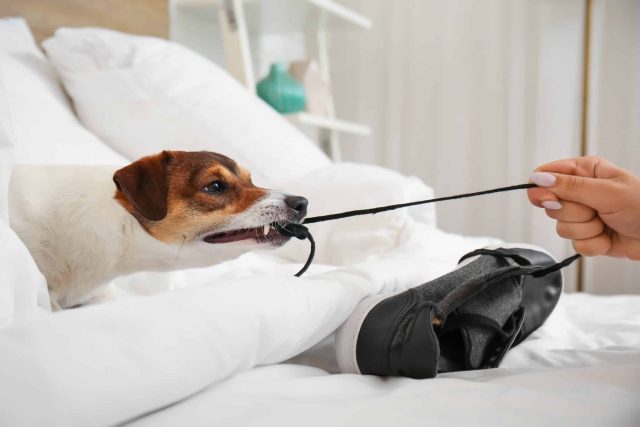
The easiest solution is also the most effective: don’t give your dog access to shoes in the first place.
Store shoes in a closet, behind a baby gate, or on high shelves where curious noses can’t reach them.
If you catch your dog carrying one of your shoes, avoid yelling or chasing them. Running after your dog can accidentally turn the situation into a fun game of keep-away.
Instead:
- Calmly offer a high-value treat or favorite toy in exchange.
- Praise your dog for choosing the appropriate item.
- Provide plenty of safe chew toys with different textures.
- Rotate toys regularly to keep them interesting.
- Increase daily exercise and mental enrichment if boredom appears to be contributing.
Positive reinforcement helps your dog learn what to chew instead of simply being punished for chewing the wrong thing.
When to Call Your Veterinarian
Occasional chewing is completely normal, but excessive or destructive chewing can sometimes signal an underlying medical or behavioral problem.
Talk to your veterinarian if your dog:
- Suddenly begins destructive chewing
- Swallows pieces of shoes or other non-food objects
- Frequently chews despite plenty of enrichment
- Shows signs of anxiety when left alone
- Develops damaged teeth or bleeding gums from chewing
- Appears obsessed with eating non-food items
Your veterinarian can help determine whether your dog is dealing with anxiety, pain, compulsive behavior, nutritional deficiencies, or another medical issue requiring treatment.
Your Dog Isn’t Trying to Ruin Your Favorite Shoes
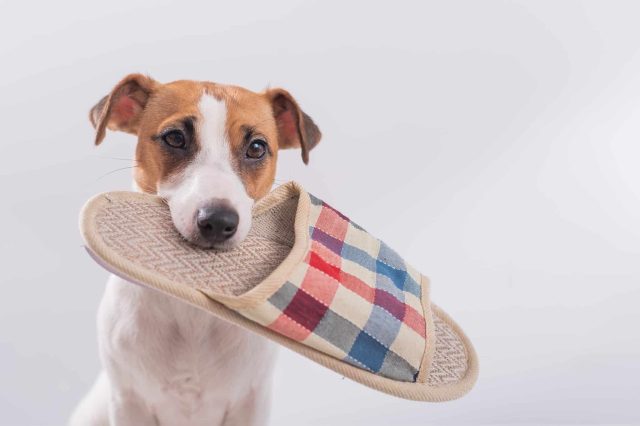
Finding a destroyed pair of shoes is never fun, but your dog isn’t acting out of spite or trying to “get back” at you. More often than not, they’re following natural instincts driven by scent, texture, curiosity, stress relief, or boredom.
By understanding the sensory motivations behind shoe chewing, managing your dog’s environment, and providing plenty of appropriate outlets for chewing and enrichment, you can help protect both your footwear and your dog’s physical and emotional well-being
 Toledo, United States.