
Picture this. You’re at the vet for a routine checkup. Your dog seems happy, energetic, basically fine. The vet glances at the scale, presses their hands along your dog’s sides, and says, “He’s carrying a bit of extra weight.” You’re genuinely surprised because to you, he looks completely normal.
You’re not alone in that reaction. And the data makes it clear why.
According to the Association for Pet Obesity Prevention (APOP)₁, 59% of American dogs are clinically overweight or have obesity. But based on APOP’s 2025 Opinion Survey₂, only 37% of dog owners categorized their own dog as overweight or obese.
That gap between what’s happening clinically and what owners actually see isn’t a story about neglect. It’s a story about how weight gain works. It’s gradual, it’s normalized over time, and our eyes adjust to the new normal without us ever noticing the shift.
Since what your dog eats has a direct impact on their weight and overall health, feeding a balanced, appropriately portioned diet tailored to your dog’s individual needs is one of the most effective ways to support a healthy weight.
Extra Weight Isn’t Just a Cosmetic Issue

It’s worth being direct here: obesity in dogs is a disease, not a body type.
A large University of Liverpool/Waltham study analyzed vet records from more than 50,000 dogs across 12 breeds and found that overweight dogs’ lifespans were up to 2.5 years shorter than those of ideal-weight dogs. Results certainly vary by dog, but in a species that averages just 10 to 13 years of life, that’s a significant chunk of time.
In addition to shorter lifespans, overweight dogs often experience a decreased quality of life due to weight-related health problems such as osteoarthritis, type 2 diabetes, certain cancers, high blood pressure, heart disease, kidney disease, and breathing problems. These aren’t edge cases in very obese dogs. Risk starts increasing at just 10% above ideal body weight, well before most owners would describe their dog as overweight at all.
The joint impact is worth singling out. One small clinical study₃ of 14 dogs with osteoarthritis found that lameness improved measurably starting at just a 6.1% reduction in body weight. For a 50-pound dog, that’s only a 3 pound weight loss. This is consistent with what veterinary professionals see in practice: modest weight loss produces real functional improvement, faster than most people expect.
Think about it this way. A dog carrying 10 extra pounds isn’t just a little fluffy. The joint load, organ strain, and metabolic impact are proportionally significant; equivalent, pound for pound, to a human carrying far more. The toll accumulates quietly, over years, in ways that don’t show up until they show up hard.
It’s Not That Owners Don’t Care. It’s That Our Eyes Adjust.

So why do nearly 60% of dogs end up overweight when their owners love them and care about their health?
The APOP data tells the story across several years. In 2023, only 17% of dog owners classified their own pet as overweight. By 2024, that figure rose to 35%. The 2025 APOP Opinion Survey put it at 37%, still less than half the actual clinical rate. More owners are recognizing the problem every year, but there’s still a significant gap between what veterinarians see and what owners report.
Gradual weight gain is nearly invisible day to day. A pound over three months looks like nothing. Ten pounds over three years looks like “filling out” or “she’s just more settled now.” By the time the weight is clinically significant, the owner’s baseline has shifted entirely, and the heavier dog looks normal.
Language matters too. APOP’s data found that veterinary professionals often soften weight-related conversations, using terms like “chonky” or “well-fed” that signal warmth but inadvertently minimize medical significance. And the same survey found that only 27% of owners recalled ever receiving a body condition score (BCS) assessment at a vet visit. Fewer than half were even familiar with what a BCS is.
The result: most owners are making feeding decisions every day with no reliable reference point for what a healthy weight looks like on their specific dog. The problem isn’t intention. It’s information.
The tool that changes this is the body condition score, and you can use it at home, right now.
Want to help your dog maintain a healthy weight without the guesswork? Answer a few questions and get a fresh, personalized meal plan with portions tailored to their unique needs. It only takes 2 minutes.
Forget the Scale. Here’s the 30-Second Check You Can Do Right Now.
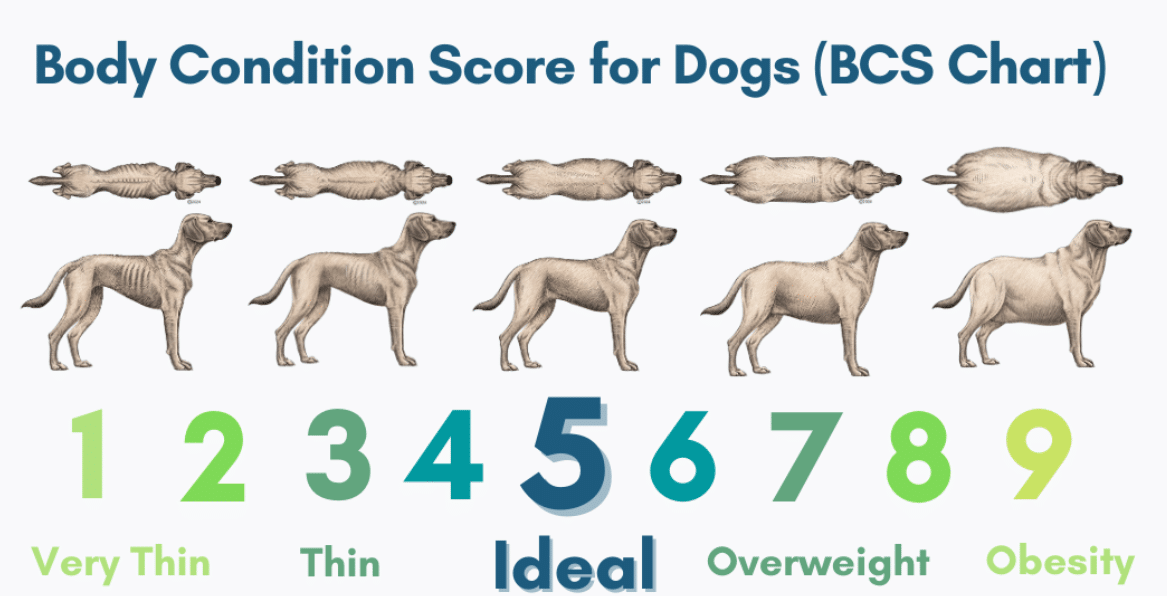
The body condition score is a standardized 9-point scale that assesses body fat and muscle distribution, not raw weight. An ideal BCS is 4 to 5 out of 9. It’s breed-agnostic, works on any size dog, and doesn’t require a scale or a vet visit.
Here’s how to do it.
The rib check. Place both hands on your dog’s ribcage, thumbs along the spine, fingers wrapping around the sides. You should be able to feel individual ribs without pressing hard, the way you’d feel the backs of your fingers when you make a loose fist. You shouldn’t see the ribs. If you have to press firmly to find them, your dog is likely carrying extra weight. If you can see them easily, they may be underweight.
The waist check. Look at your dog from directly above. You should see a visible narrowing of the body behind the ribs, similar to an hourglass shape. From the side, the abdomen should tuck upward toward the hindquarters rather than hanging level or drooping.
Neither check requires any equipment. Both take about 30 seconds. Do it now, before reading on.
If the ribs are hard to feel or there’s no visible waist, your dog is likely carrying extra weight. That’s not a diagnosis; your vet can provide an official BCS assessment and a target weight. But it’s a reliable at-home signal, and it’s what vets use as a starting point.
The Instructions on the Bag Were Not Written for Your Dog

Here’s the structural problem most owners don’t know about.
Kibble feeding guidelines are calculated for an average dog at a given weight. Not your dog. The average. That means no adjustment for breed, age, activity level, reproductive status, or individual metabolism. A sedentary, spayed, 7-year-old Lab and an active, intact, 2-year-old Lab of the same weight have very different calorie needs. The bag can’t tell them apart.
The ranges themselves are broad: a 30-50% difference in calorie intake between the low and high end of a single feeding guideline is common. Owners measuring by cups don’t realize that the same cup of different foods can vary dramatically in calorie density. And because every serving slightly over the right amount adds up invisibly over months and years, the systematic drift toward overfeeding is almost mechanical.
In addition, factors like age, activity level, and spay/neuter status can significantly affect your dog’s caloric needs. According to Dr. Ernie Ward, founder of the Association for Pet Obesity Prevention (APOP), spaying or neutering a dog may reduce their energy requirement by 20–30%.
“So already, if you’re feeding according to guidelines, you’re overfeeding a pet who is spayed or neutered,” Dr. Ward says. “I see so many pet owners say ‘I’m feeding exactly what they say on the bag,’ and it’s like ‘no, that’s too much.’”
This isn’t a single-brand problem. It’s a format problem. The bag wasn’t designed to personalize and there are manufacturer incentives that favor suggesting more, not less.
The Farmer’s Dog takes the opposite approach. Every plan is built around the individual dog: age, breed, current weight, activity level, spay/neuter status. The food arrives in pre-portioned packs calibrated to that dog’s actual calorie needs. No pouring, no estimating, no range to interpret. If the plan needs adjustment as your dog’s weight changes, it adjusts.
See what your dog’s actual daily portion should be. Build their profile in about 2 minutes.
This Is One of the Most Impactful Things You Can Do for Your Dog’s Life
Weight loss in dogs is slow on purpose.
Veterinary guidelines target roughly 1 to 2% of body weight per week. For a 60-pound dog, that’s less than a pound a week. Faster weight loss risks muscle loss and nutritional deficiency, both of which undermine the health gains you’re going for in the first place. The pace isn’t a limitation. It’s the safe way to do it.
One of the clearest examples of what this looks like in practice is Franklin.
His owner watched him go from 100 pounds down to 85 over about 13 weeks. That’s 15 pounds off a 100-pound dog, roughly 1.2% of body weight per week, right in the middle of the recommended veterinary range. Slow and steady, exactly as intended.
Here’s how his owner described it:
“He went from 100 pounds to 85 in 3 months. His coat looks better; thicker, softer, and shinier. He has less stomach issues. Bonus, he loves it and never seems bored of it.”
A few things worth pointing out about Franklin’s results:
- The coat and digestion improvements happened alongside the weight loss, not after it. Those are changes owners notice in weeks, before the scale tells the full story.
- The fact that Franklin “never seems bored” with his food is essential to his success. Palatability is often the hidden reason weight management diets fail. Dogs that don’t eat their food enthusiastically don’t stay on it.
Franklin’s results aren’t an anomaly. They’re what happens when the portions are right, the food is palatable, and the plan matches the individual dog. The 1.2% weekly loss rate is actually the proof that the approach was calibrated correctly: not too fast, not stalled.
Discover your dog’s perfect portion today and get 50% off your first box.
FAQs: Your Questions About Dog Weight, Answered
Q1: What percentage of dogs in the US are overweight?
APOP’s most recent U.S. Pet Obesity Prevalence Survey found that 59% of US dogs are clinically overweight or have obesity₁. The gap with owner perception is the real story: APOP’s 2025 Opinion Survey found that just 37% of dog owners described their own pet as above ideal weight₂, up from 35% in 2024 and just 17% in 2023. Owner recognition is climbing, but it’s still less than two-thirds of the actual clinical rate. The same 2025 survey found 56% of dog owners were actively trying to help their dog lose weight, but only 28% reported their dog had reached a healthy target weight, pointing to a precision problem as much as an awareness problem.
Q2: How do I know if my dog is overweight?
The most reliable at-home method is the body condition score (BCS). Feel for ribs without pressing hard. Look for a visible waist from above and a belly tuck from the side. If you can’t feel ribs clearly or there’s no visible waistline, your dog is likely carrying extra weight. Your vet can provide an official BCS assessment and a target weight; only 27% of owners report ever receiving one, so it’s worth asking specifically.
Q3: What health problems are linked to dog obesity?
Osteoarthritis, type 2 diabetes, certain cancers, heart disease, kidney disease, high blood pressure, and breathing difficulties are the most common, with risk increasing meaningfully even at 10% above ideal body weight. One small published study of 14 dogs found that lameness in dogs with osteoarthritis improved starting at just a 6.1% reduction in body weight₃. The health consequences start well before a dog looks obviously overweight.
Q4: How much longer do lean dogs live compared to overweight dogs?
A University of Liverpool/Waltham study of more than 50,000 dogs across 12 breeds found that overweight dogs’ lifespans were up to 2.5 years shorter than those of ideal-weight dogs. In a species averaging 10 to 13 years, that’s a significant portion of a dog’s life, and body weight is one of the few longevity factors an owner can directly influence through day-to-day feeding decisions. Results may vary.
Q5: How fast should my dog lose weight?
Vets typically target 1 to 2% of body weight per week. Faster than that risks muscle loss and nutritional deficiency. Monthly weigh-ins are usually enough to track progress. What doesn’t work: switching to a “light” kibble that’s still imprecisely portioned, cutting food dramatically without veterinary guidance, or trying to outrun the food equation with exercise alone. Activity matters, but the calories-in side of the equation is where weight management actually happens.
Q6: Why does kibble make dogs gain weight?
It’s less about kibble itself and more about how feeding guidelines work. Bag instructions are based on an average dog of a given weight, with no adjustment for breed, age, activity, or metabolism. Most owners measure by volume rather than calories, and the same cup of different foods varies significantly in calorie density. Systematic overfeeding by even a small amount per day compounds over months and years. Pre-portioned fresh food calibrated to an individual dog’s profile removes that guesswork entirely.
Q7: What’s the best food for a dog that needs to lose weight?
The most important factor is whether portions are accurately calibrated to the dog’s actual calorie needs. Fresh food with high moisture content can support satiety at lower caloric density, and pre-portioned plans remove the measurement guesswork that causes gradual overfeeding. The Farmer’s Dog builds each plan around the individual dog’s profile, including adjustments for dogs working toward a healthier weight, with recipes developed by on-staff Board-Certified Veterinary Nutritionists.
The Best Way to Support Your Dog’s Health and Longevity

Here’s the bottom line on weight and longevity: it’s one of the highest-leverage things you can do for how long and how comfortably your dog lives. The research on lean body weight is consistent across multiple large studies. And unlike genetics or breed-specific risks, body weight is something you can directly influence through feeding decisions starting today.
You don’t need to be perfect. You need a reliable baseline and a clear way to tell whether it’s working.
The Farmer’s Dog removes the hardest part: the guessing.
Every plan is built for your specific dog by on-staff Board-Certified Veterinary Nutritionists and arrives pre-portioned to your door, so the right amount is the default, not something you calculate every meal.
 Toledo, United States.