
This guide covers both Pembroke and Cardigan Welsh Corgis, with detailed weight and height charts from newborn through age 3. You’ll also find feeding amounts by age, how to spot an unhealthy weight, and answers to the questions most owners search for but don’t always find.
Quick note: these are averages based on breed standards and vet guidance. Your dog’s genetics, diet, and activity level will shift the numbers somewhat. If something feels off, a quick vet check is always worth it.
- Pembroke adult weight: 22-30 lbs (female), 24-31 lbs (male)
- Cardigan adult weight: 25-34 lbs (female), 30-38 lbs (male), per the AKC Cardigan Welsh Corgi breed standard (last reviewed 2023)
- Adult height: 10-12 inches at the shoulder for both breeds
- Full grown: Most Corgis reach adult height by 12 months, adult weight by 18 months
- AKC breed standard: Pembrokes should not exceed 30 lbs (female) or 30 lbs (male)
- Biggest risk: Biggest risk: Obesity (Corgis are food-motivated and prone to weight gain)
Pembroke vs. Cardigan: Two Breeds, Two Size Ranges
People often treat Corgi as a single breed, but there are actually two distinct ones: the Pembroke Welsh Corgi (the one without a tail, usually associated with Queen Elizabeth) and the Cardigan Welsh Corgi (the larger one with a full, fox-like tail). They look similar but they’re not the same breed genetically.
Cardigans are noticeably heavier-boned and tend to run about 5-8 lbs heavier than Pembrokes at full maturity. So if your Cardigan weighs more than a Pembroke growth chart suggests, that’s totally expected. Make sure you’re using the right chart for your dog.
Pembroke Welsh Corgi Weight by Age
Pembrokes are the more popular of the two breeds, and their size range is a bit tighter. Males cap out around 30 lbs and females around 28 lbs by AKC standards (last reviewed 2023). That said, plenty of perfectly healthy Pembrokes run slightly outside these numbers depending on their frame.
Male Pembroke Welsh Corgi Weight and Height by Age
Female Pembroke Welsh Corgi Weight and Height by Age
Cardigan Welsh Corgi Weight by Age
Cardigans grow a bit slower than Pembrokes and tend to reach full size between 14-18 months. They’re also stockier through the chest. A male Cardigan at 35 lbs is within normal range. That same weight on a Pembroke would be overweight. Keep that in mind as you track your dog’s progress.
Male Cardigan Welsh Corgi Weight and Height by Age
Female Cardigan Welsh Corgi Weight and Height by Age
Corgi Growth Stages: What to Expect Month by Month
Corgi puppies go through fast changes in their first year. Here’s what’s actually happening at each stage:
Newborn to 2 months: Puppies are entirely dependent on their mother. They’re born with eyes and ears sealed. By 8 weeks they’re playful, exploring, and usually ready to go to new homes. At this stage they’re roughly 8-12 lbs depending on breed.
3 to 4 months: This is when the rapid growth phase kicks in. Your puppy might look a little gangly, with big ears that haven’t quite caught up to their body. Their appetite spikes too. You’ll notice their little back legs getting stronger as they start to run and zoom around the yard.
5 to 6 months: They’re starting to look like a real Corgi now. This is also when most puppies hit the beginning of their teething phase, which lasts until about 7 months. Good time to stock up on durable chew toys. Height growth is still happening, but it’s slowing down.
7 to 12 months: Most Corgis reach close to their adult height by 9-10 months. The last few months of the first year is more about filling out in the chest and gaining muscle. They’ll look less puppy-like and more like a small, solid adult dog.
12 to 18 months: This is when weight stabilizes for Pembrokes. Cardigans may continue adding a pound or two through 18 months. By this point, your dog should be eating adult food rather than puppy formula. Switching to one of the best puppy foods for Corgis during the first year gives them the right nutrition to support this growth.
How Much to Feed Your Corgi by Age
Corgis are notorious food hounds. They’ll eat anything you put in front of them and still stare at you like they haven’t eaten in days. So portion control matters from day one. These amounts assume a standard dry kibble at about 370-400 calories per cup:
One thing worth knowing: always check the specific feeding guidelines on your dog’s food bag, since calorie density varies quite a bit. A good puppy supplement can fill in any nutritional gaps during the first year, especially if you’re feeding a less premium kibble.
If your Corgi is already looking chunky by 6 months, scale back slightly rather than waiting. Overfeeding in puppyhood creates fat cells that stick around for life.
How to Tell If Your Corgi Is at a Healthy Weight
Numbers on a scale only tell part of the story. Body condition scoring is actually more useful day-to-day. Here’s what to check:
Run your hands along your dog’s ribs. You should be able to feel individual ribs without pressing hard, but they shouldn’t be visually obvious from across the room. If you can’t feel ribs at all, your dog is likely carrying too much weight. If they look like a xylophone, they might be underweight.
Look from above. A Corgi at a healthy weight will have a noticeable waist, a narrowing behind the rib cage when viewed from directly above. If the sides are completely straight or bulging outward, that’s a red flag.
Look from the side. The belly should tuck up slightly behind the rib cage, not hang down flat or droop. Corgis have longer torsos, so this tuck can be subtle, but it should be there.
For Corgis specifically, their long backs make obesity especially harmful. Extra weight puts pressure on the intervertebral discs and significantly raises the risk of disc disease. If you’re ever unsure, ask your vet to score your body condition score at the next checkup.
Supporting joint health from an early age is smart with this breed. Many owners start their Corgis on hip and joint supplements as early as 1-2 years, especially if the dog is active on hard surfaces. And if your dog is heading into their senior years, senior Corgi supplements can help maintain mobility and energy.
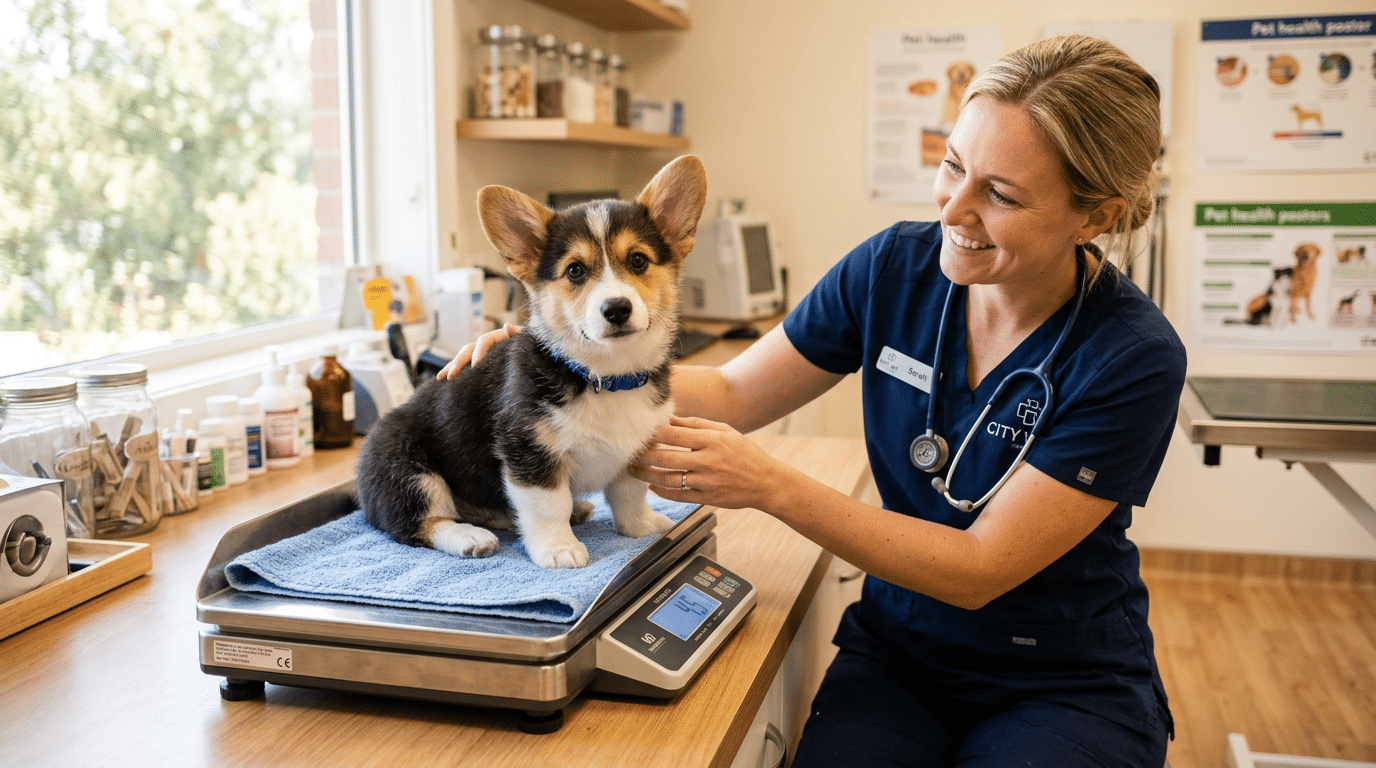

The Bottom Line
Tracking your Corgi’s weight by age isn’t about hitting exact numbers. It’s about knowing the range and making sure your dog stays inside it. Both Pembroke and Cardigan Corgis are prone to weight gain, and their long backs pay the price when they carry too much. Use the charts above as a benchmark, do the rib and waist check every few weeks, and don’t ignore early signs of obesity.
Most Corgis hit their adult height by 12 months and full adult weight by 18 months, according to AKC growth guidelines (last reviewed 2024). Until then, good nutrition is everything. Start with a quality puppy food, feed measured portions rather than free-feeding, and don’t let those big brown eyes guilt you into extra treats. They’re good at that.
If you have concerns about your dog’s growth at any point, a quick vet visit will give you a body condition score and a personalized feeding recommendation. That’s worth more than any chart. For ongoing Corgi health, consider adding a solid flea and tick prevention routine to your care plan. It’s one of those things that’s easy to overlook until you’re dealing with a problem. If you’re also tracking growth in other breeds, our male vs. female American Staffordshire Terrier weight and height guide follows the same format.
- CBD for Corgis: What You Need to Know
- Best Supplements for a Senior Corgi
- Best Flea & Tick Products for Corgis
- Best Online Dog Training Courses for Corgi
- Best Hip & Joint Supplement for a Corgi
- What Supplements Should I Give a Corgi Puppy?
- The 9 Best Corgi Puppy Foods
- Best Dog Beds for Corgis
- Improve Your Corgi’s Skin & Coat with This One Hack
- Giving This to Your Corgi Daily Can Alleviate Itchy Allergies
- 6 Natural Ingredients to Fight Your Corgi’s Allergies
- 8 Ways to Stop Your Corgi’s Scratching
- 7 Ways to Calm Your Corgi’s Anxiety
- 6 Remedies for Your Corgi’s Diarrhea, Gas, or Vomiting
- 7 Best Dental Chews for a Corgi
 Toledo, United States.