
You finally have the puppy home. And somewhere between the breeder’s advice, the wall of bags at the store, and three blog posts that all disagree, the same question keeps surfacing: what should you actually feed them, and how much?
Here is the short answer, and the thesis of this whole guide: a puppy’s first year is a one-time window. The food and the portions you choose during growth do not just affect how your puppy feels now; they help shape the adult dog they become, especially when it comes to their joints and a healthy weight.
Research is starting to point in the same direction. One large observational study of more than 4,000 dogs found an association between certain puppyhood diets and fewer owner-reported skin issues later in life₁. That is a correlation, not proof, and results vary from dog to dog. But it lines up with decades of growth research on one point: the early bowl matters.

None of this requires being perfect, and it definitely does not require buying the fanciest thing on the shelf. It comes down to a few high-leverage decisions, most of which are simpler than the aisle makes them look. (If you want the fuller day-to-day picture beyond feeding, The Farmer’s Dog complete puppy care guide is a good companion to this article.)
By the end of this guide, you will know the weaning timeline, what “growth” actually requires of a food, why large-breed puppies need special care, how to decode the AAFCO life-stage label in about ten seconds, and the one feeding mistake that quietly causes lifelong problems.
Your Puppy’s Nutrition Needs Shift Fast. Here Is the Rough Calendar
Puppies typically begin transitioning from their mother’s milk to solid food around 6 to 7 weeks of age, and the move should be gradual. By the time a puppy goes home with you, usually at 8 weeks or later, they are almost always eating puppy food already.
What surprises many new owners is how long the growth phase lasts. Most puppies are considered “growing” and need a growth-appropriate diet until they reach adult size. For many dogs, that is roughly 10 to 12 months. For large and giant breeds, it can stretch to 18 to 24 months. Switching to adult food too early shortchanges a body that is still under construction.
Meal frequency changes along the way, too. Young puppies generally do best with more frequent, smaller meals, often three or more a day, tapering toward a steadier routine as they mature.

One principle holds throughout: meal-feeding with set portions beats leaving food out all day. Free-choice feeding makes it nearly impossible to track how much a growing puppy is actually eating, and as you will see in the large-breed section, that matters more than most owners realize.
When you do change foods at any point, make the switch gradually over several days to a week, mixing increasing amounts of the new food into the old to support digestion. The Farmer’s Dog’s week-by-week puppy feeding guide breaks this timeline down in more granular detail, and their overview of puppy development stages in the first six months shows what is happening in the body behind each shift.
One reassurance before we go deeper: exact timing varies by breed and by individual dog, and results may vary. Your veterinarian is the best source for your puppy’s specific schedule and target growth rate. What follows are the principles that hold across the board.
|
Not sure where your puppy is in their growth stage? Tell The Farmer’s Dog about your puppy’s age, breed, and weight, and get a fresh plan built around the stage they are in right now, and as they grow. |
Growing Puppies Do Not Just Need More Food. They Need Food They Can Actually Use

Growth is metabolically expensive. A puppy is building muscle, bone, organs, and a nervous system all at once, which is why puppies need more energy and more high-quality protein per pound of body weight than adult dogs do. “Puppy food” is not a marketing size; it is a genuinely different nutritional job.
But there is an underrated second half to the equation: digestibility. It is not just what is in the bowl; it is how much of it your puppy’s body can absorb and put to work. Fresh, gently cooked food is clinically proven to be highly digestible, which means more of the food’s nutrients are actually available to a fast-growing body. A visible bonus most owners notice within weeks: smaller, firmer stools, because less of the food is passing through unused.
At a high level, a complete and balanced growth diet should deliver quality protein for tissue growth along with the omega-3 fatty acids EPA and DHA, which support brain and eye development during this stage. The point is not any single magic ingredient. It is that the whole diet is formulated for growth and made in a way a young digestive system can use.
This is also where the “fancy food” worry deserves a rest. The goal is not gourmet. It is real, fresh food made to a standard you can trust: human-grade, gently cooked, and complete and balanced for growth. That is the standard The Farmer’s Dog was built around, and it is part of why fresh food suits puppies so well.
With Big Puppies, Growing Too Fast Is a Real Risk, Not Just a Cute Phase

Here is the section that matters most if your puppy will weigh 70 pounds or more as an adult. In large- and giant-breed puppies, growing too fast is a documented risk. Excess calories and rapid growth, along with too much calcium, are linked to developmental orthopedic problems affecting the joints and growth plates.
The most important nuance in that research: rapid growth driven by overfeeding, meaning simply too many calories, appears to be the most prevalent risk factor, even more than calcium alone. That reframes something many owners find counterintuitive. A slightly chubby large-breed puppy is not extra-healthy or adorably ahead of schedule. They may be growing at an unsafe rate.
“Bigger faster” is the wrong goal. A large-breed puppy will reach their full genetic size either way; the question is whether they get there at a pace their skeleton can keep up with. The aim is steady, controlled growth to a lean body condition, because slower, steadier growth gives joints and growth plates time to develop properly.

In practice, that means a growth diet with appropriate calorie density and controlled calcium, fed in measured portions rather than free-choice, with body condition checked regularly. During this window, modest underfeeding is generally safer than overfeeding, though a lean, steady middle is the real goal, and results may vary by dog. (If you are worried your puppy is too thin rather than too heavy, The Farmer’s Dog’s guide to what to feed a puppy for healthy weight gain covers how to tell the difference.)
Now for the honest, practical problem. The hardest part of all this is not choosing the food. It is portioning: knowing exactly how much to feed a moving target whose needs change week to week. That is precisely the guesswork that pre-portioned packs, calibrated to an individual puppy’s profile, are designed to remove. When each meal arrives already measured for your puppy’s current stage, it becomes much harder to accidentally overfeed during the riskiest growth window.
|
Take the guesswork out of how much to feed during growth. The Farmer’s Dog builds each plan around your individual puppy, based on their age, breed, weight, and activity, and delivers it in pre-portioned packs calibrated to their needs. No scooping, no estimating, no accidental overfeeding during the window that matters most. |
One Sentence on the Bag Tells You If a Food Is Actually Right for a Puppy
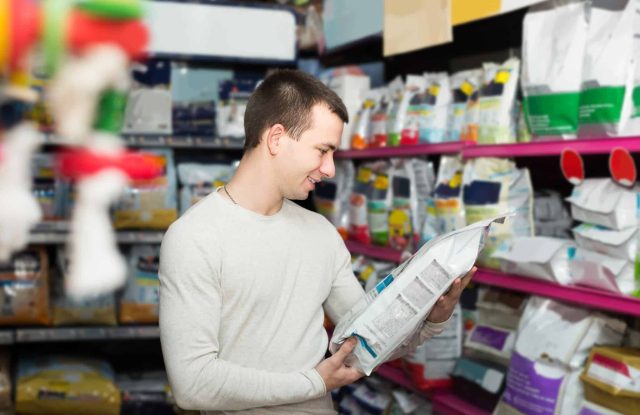
Here is a ten-second skill most owners skip. Somewhere in the small print on the back or side of any dog food package is the AAFCO nutritional adequacy statement, one sentence that tells you which life stage the food is formulated for. It is the fastest way to know whether a food is appropriate for a puppy at all.
The plain-English translation: “growth” and “all life stages” both cover puppies. “Adult maintenance” does not, and it is not appropriate as a growing puppy’s primary diet.
If you have a big dog on the way, there is one more line to look for. For large breeds, the statement should say the food is formulated for growth, “including the growth of large size dogs (70 lbs or more as an adult).” That specific phrase is your signal that the calcium and calorie considerations from the previous section were accounted for in the formula.
The statement also reveals one more useful detail: whether the food was formulated to meet an AAFCO nutrient profile or substantiated through an AAFCO feeding trial. Both are valid paths; it is simply worth knowing which one you are looking at.
Here is the whole decoder at a glance:
| What the label says | Right for a puppy? | What it actually means |
|---|---|---|
| “…for growth” | Yes | Formulated for puppies and the growth life stage |
| “…for all life stages” | Yes | Meets the growth standard, so it covers puppies too |
| “…including growth of large size dogs (70 lbs+)” | Yes, for large breeds | Growth formula with large-breed calcium and calorie considerations |
| “…for maintenance” | No | Adult-only; not formulated for growing puppies |
| No AAFCO statement | Be cautious | Nutritional adequacy is not substantiated on the label |
The simple test: a puppy’s food should say “growth” or “all life stages,” plus the large-breed line if you have a big dog. If it only says “maintenance,” it is built for adults.
|
Want a puppy plan that already meets the growth standard? The Farmer’s Dog is freshly made, human-grade food, AAFCO complete and balanced, and formulated by On-Staff Board Certified Veterinary Nutritionists®, with plans calibrated to your puppy’s growth stage and delivered pre-portioned to your door. |
FAQs for Feeding Your Puppy in the First Year

When can puppies start eating solid food?
Puppies typically begin weaning from their mother’s milk to solid food around 6 to 7 weeks of age, transitioning gradually. By the time a puppy goes home with a new owner, they are usually already eating puppy food. Your veterinarian can confirm the right timing for your specific puppy.
How long should a dog eat puppy (growth) food?
Most puppies need a growth-formulated diet until they reach adult size, often around 10 to 12 months for many breeds, and up to 18 to 24 months for large and giant breeds. Switching to adult food too early can shortchange a still-growing body, so timing should match your dog’s breed and size.
How much should I feed my puppy?
Enough to support steady, healthy growth and a lean body condition, not as much as they will eat. The right amount changes constantly as a puppy grows, which is why measured, meal-fed portions beat free-choice feeding, and why overfeeding during growth is a real risk, especially for large breeds. Pre-portioned plans calibrated to your puppy’s profile remove the guesswork. For a granular breakdown by age, see The Farmer’s Dog’s week-by-week puppy feeding guide.
What does “growth” or “all life stages” mean on a dog food label?
It is the AAFCO nutritional adequacy statement, and it tells you which life stage a food is formulated for. “Growth” and “all life stages” both cover puppies; “adult maintenance” does not. For a large-breed puppy, look for wording that includes “the growth of large-sized dogs (70 lbs or more as an adult).”
Is special food really necessary for large-breed puppies?
It is worth taking seriously. Large- and giant-breed puppies are more prone to developmental orthopedic problems when they grow too fast, and excess calories and calcium are linked to that risk. A growth diet with appropriate calorie density and controlled calcium, fed in measured portions, supports the steady growth their joints need. Results may vary; your vet can advise on your puppy.
Does what I feed my puppy now really affect them as an adult?
It can. Early-life nutrition supports development during a one-time growth window, and steady growth to a lean weight is associated with better long-term joint health and a healthy adult weight. One large observational study even linked certain puppyhood diets with fewer owner-reported skin issues later in life, though that is an association rather than proof. The consistent takeaway: the early bowl is a long-term investment. Results may vary.
Can I feed my puppy fresh food from The Farmer’s Dog?
Yes. The Farmer’s Dog is great for puppies and can be fed right after weaning. It is freshly made, human-grade food, formulated by On-Staff Board Certified Veterinary Nutritionists® to be AAFCO complete and balanced, and each plan is calibrated to your puppy’s growth stage and delivered pre-portioned. As your puppy grows, you can update their information so their food keeps pace. Read more on why The Farmer’s Dog is great for puppies.
How do I switch my puppy to a new food without upsetting their stomach?
Transition gradually over about a week, mixing increasing amounts of the new food with the old to give their digestion time to adjust. Fresh, gently cooked food tends to be highly digestible, which can make transitions smoother. If your puppy ever turns their nose up along the way, this guide to what to do if your puppy is not eating can help, and The Farmer’s Dog offers 24/7 support from real people.
Get the First Year Right, and You Are Investing in Every Year After

Pull the threads of this guide together, and they all point in the same direction: the first year is a foundation you only build once. Steady growth, a lean and healthy weight, and a complete and balanced growth diet set a puppy up for a more comfortable adult life, especially where their joints are concerned.
The healthy-weight connection deserves its own sentence, because it is one of the best-supported findings in canine health: keeping a dog at a lean, healthy weight is among the most impactful things an owner can do for long-term wellbeing, and lean dogs can live up to 2.5 years longer. That habit does not start at age five. It starts in puppyhood, with portions that match the dog’s real needs instead of the dog’s enthusiasm. As always, results may vary from dog to dog.
And the near-term payoffs show up long before the long-term ones. Owners who start fresh food during puppyhood tend to notice the visible stuff within weeks: easy mealtimes, good digestion with smaller, firmer stools, steady energy, and a healthy build as the puppy grows. Those everyday signals are the early evidence that the foundation is going in the right direction.
That is exactly how it has played out for Maple, a 7-month-old Mini Bernedoodle who has grown up on The Farmer’s Dog since she was a puppy.
“Maple has grown up the last 6 months on The Farmer’s Dog. Her favorite is the Chicken recipe! She gets so excited when the next shipment arrives and loves to play in the box too! She’s very healthy and full of energy and very content after her meals,” her owner shares.
Excitement at mealtime, steady energy, a healthy build, and contentment after eating: those are the everyday, visible signs of a growth diet doing its job. And they show up months before the long-term benefits do. As with any dog, results may vary, but Maple’s first year is what the foundation looks like while it is being built.
|
Give your puppy a strong start, without the guesswork. Freshly made, human-grade food, formulated by On-Staff Board Certified Veterinary Nutritionists® to be AAFCO complete and balanced, calibrated to your puppy’s growth stage, and delivered pre-portioned to your door, backed by 24/7 support from real people. ▶ Create Your Puppy’s Plan in 2 Minutes & Save 50% Off Your First Order |
 Toledo, United States.