
If you’ve ever watched a 140-pound dog try to climb into someone’s lap, you already know the joke: some of the biggest dogs on the planet act like they weigh ten pounds and believe every inch of the couch belongs to them. Large dog breeds that are gentle giants have a reputation that runs completely opposite to their size. These dogs are affectionate, soft-hearted, and happily goofy in ways that never stop being funny once you live with one.
Whether you’re already sharing your home with one of these lovable giants or you’re thinking about it, this guide covers eight breeds that prove size and sweetness go hand in hand. Each one has its own personality, quirks, and absolutely zero sense of personal space. If you’ve been wondering which large dog breeds act like lap dogs, you’re in exactly the right place.
Why These Large Dog Breeds Are Actually Total Softies
There’s a common misconception that a big dog means a guarded, serious dog. In reality, many of the largest breeds were developed to work alongside people, guarding livestock, pulling sleds, or rescuing travelers. That kind of close cooperation with humans over generations tends to produce dogs that are deeply bonded, emotionally intuitive, and very comfortable around the people they love.
These eight breeds share a few things in common: a calm temperament (most of the time), a serious love of physical contact, and a complete inability to understand why you’d want the bed to yourself. They’re not identical in personality, but they’re all united by that gentle-giant spirit that makes big dog owners say they could never go back to a smaller breed.
Quick Size Comparison: The 8 Gentle Giants
| Breed | Avg. Weight | Avg. Height | Personality in One Word |
|---|---|---|---|
| Saint Bernard | 120-180 lbs | 26-30 in | Nurturing |
| Great Dane | 110-175 lbs | 28-32 in | Dignified |
| Newfoundland | 100-150 lbs | 26-28 in | Devoted |
| Bernese Mountain Dog | 70-115 lbs | 23-27 in | Cheerful |
| Irish Wolfhound | 105-120 lbs | 30-35 in | Gentle |
| Leonberger | 90-170 lbs | 25-31 in | Majestic |
| Great Pyrenees | 85-115 lbs | 25-32 in | Patient |
| Mastiff | 120-230 lbs | 27-30 in | Steadfast |
1. Saint Bernard: The Original Rescue Hero Who Just Wants to Cuddle
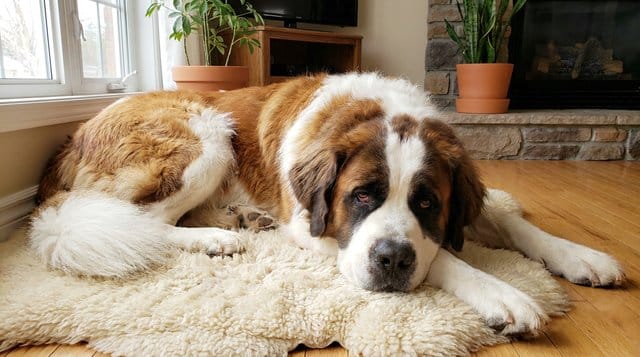
The Saint Bernard is possibly the most famous gentle giant on this list, and for good reason. These dogs were bred by Swiss monks to rescue travelers lost in the Alps, which tells you everything about their nature: patient, calm under pressure, and deeply connected to the humans around them. A Saint Bernard doesn’t just tolerate your presence. It actively seeks you out for contact.
Despite their impressive bulk, Saint Bernards are notoriously soft with children and adapt surprisingly well to family life. They can be a bit slow-paced and don’t need hours of intense exercise, but they absolutely require daily activity and plenty of mental stimulation. They’re also champion droolers. If you’re particular about dry floors, this is important to know upfront.
What catches most new Saint Bernard owners off guard is how emotionally sensitive these dogs are. Raised voices or tension in the house genuinely affect them. They thrive in calm, affectionate homes where they can keep a watchful eye on everyone they love.
2. Great Dane: The Gentle Apollo Who Needs Half Your Couch
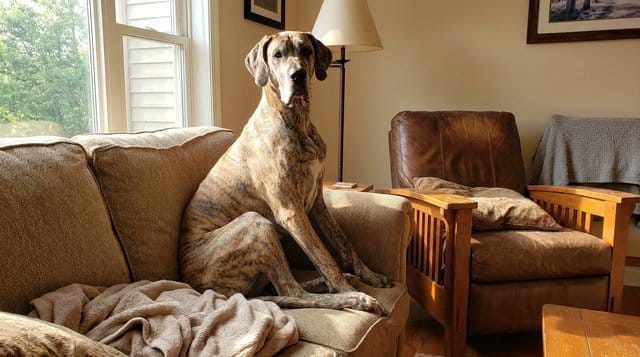
Known as the Apollo of dogs, the Great Dane stands as one of the tallest breeds on the planet. On their hind legs, many can look an average adult straight in the eye. And yet, ask any Great Dane owner and they’ll tell you the same thing: this dog has no idea how big it is.
Great Danes are warm, affectionate, and sometimes goofily unaware of their physical impact on the world around them. They’ll lean into you with their full body weight like you’re a piece of furniture they’ve claimed. They’ll attempt to sit in your lap on a regular basis. And they’ll likely be genuinely puzzled when you try to redirect them to the actual dog bed on the floor.
These dogs do best in homes with space to move, but their exercise needs are more moderate than you might expect. Short daily walks and playtime keep them happy. Their bigger requirements are emotional: Great Danes want to be near their families as much as possible. They don’t do well left alone for long stretches, and they can become anxious or destructive when isolated regularly.
3. Newfoundland: The Nanny Dog With a Bear-Sized Heart
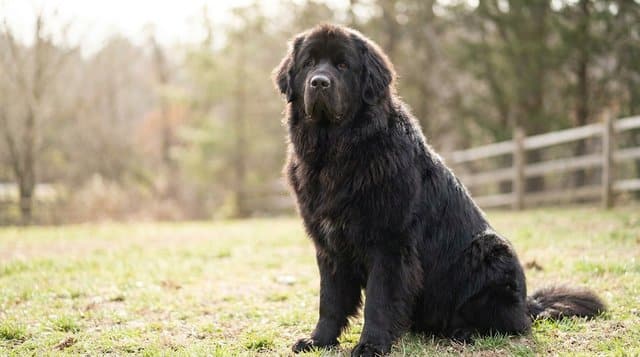
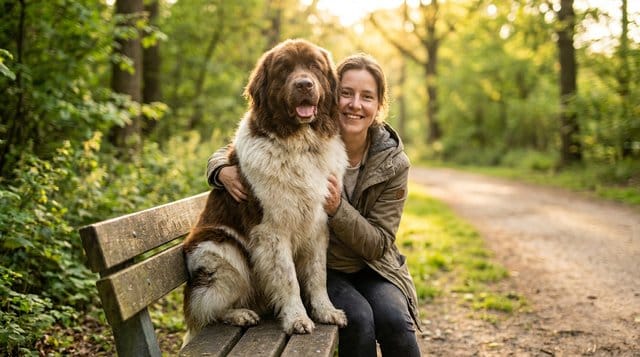
Newfoundlands were originally bred to work alongside fishermen off the coast of Canada, hauling nets and rescuing people who fell overboard. Their webbed feet, thick water-resistant coat, and powerful build made them ideally suited for cold-water rescues. What makes them remarkable isn’t just the physical capability, though. It’s the instinct to protect and care for people that seems hardwired into every Newfie.
J.M. Barrie famously based the dog Nana in Peter Pan on a Newfoundland, and that captures them perfectly. They’re nurturing, patient, and particularly gentle with children. Many Newf owners describe their dogs as deeply intuitive, seeming to sense when someone is struggling or needs comfort.
The trade-off with a Newfoundland is the coat. It’s magnificent and thick, perfect for cold weather, and it sheds constantly. If you’re bringing a Newfie home, invest in a good vacuum and a solid grooming routine. You’ll also want a shady spot and a wading pool in summer because this breed doesn’t love heat. But in terms of temperament? These dogs are genuinely among the sweetest animals you’ll ever share your life with. Check out how other snuggly dog breeds handle personal space and you’ll see Newfs right at the top of the list.
4. Bernese Mountain Dog: The Cheerful Tricolor Who Lives to Please
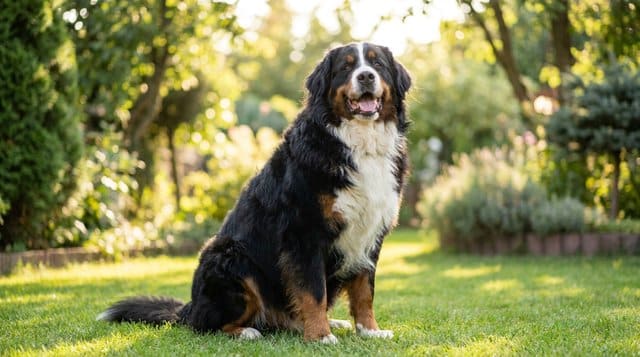
The Bernese Mountain Dog is one of the most visually striking of the gentle giants, with its beautiful tri-color coat of black, white, and rust. Originally a Swiss working farm dog used for drafting and herding, the Berner has made an effortless transition into family life. They’re enthusiastic, playful, and genuinely joyful in a way that’s hard to describe until you’ve experienced it.
Berners love being involved in whatever you’re doing. Garden work, hiking, watching TV on a Sunday afternoon, they want to be right there with you. They’re known for their calm temperament with kids and their adaptability in multi-pet households. Unlike some larger breeds that can be stubborn, Berners are highly responsive to training and eager to please.
One thing to be aware of with the Bernese Mountain Dog is their lifespan. Sadly, like many large breeds, they don’t live as long as smaller dogs, typically 7-10 years. That makes the time you have with them feel all the more precious. Their thick double coat also means grooming is a commitment, especially during shedding seasons. If you love the idea of a shaggy dog breed that makes grooming an experience, the Berner delivers on that front.
5. Irish Wolfhound: The Ancient Giant With a Philosopher’s Soul
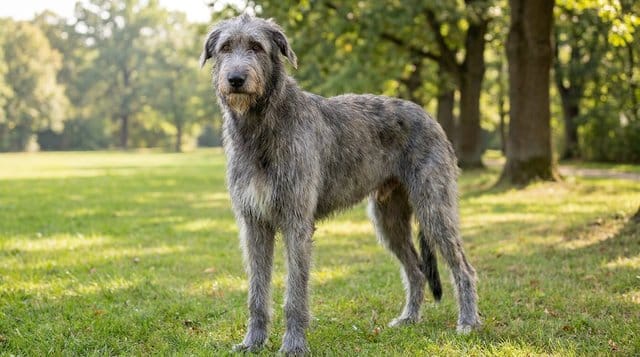
The Irish Wolfhound is the tallest breed recognized by the AKC, and in person, they’re genuinely breathtaking. Standing up to 35 inches at the shoulder, a full-grown Irish Wolfhound looks like something out of mythology. In ancient Ireland, these dogs were prized by chieftains and celebrated in poetry. Only the nobility could own them, and they were sometimes given as royal gifts.
Despite that regal history, the Irish Wolfhound is one of the quietest, most laid-back dogs you’ll ever meet in daily life. They’re not aggressive or territorial. They’re not particularly loud. They move at a thoughtful pace through the world, which belies the explosive speed they’re capable of when they actually run. At home, they’re calm companions who love a good lounge on a soft surface.
Irish Wolfhounds are deeply loyal and sensitive to their families, but they’re not clingy in the way some breeds are. They’re more like a quiet friend who’s always glad you’re around. They do need space, though. A small apartment is not a great fit for a dog that can stretch out to the length of a small table.
6. Leonberger: The Lion-Maned Gentle Giant Who Loves Everyone
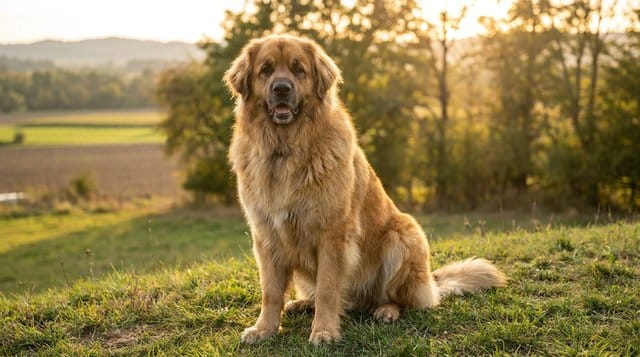
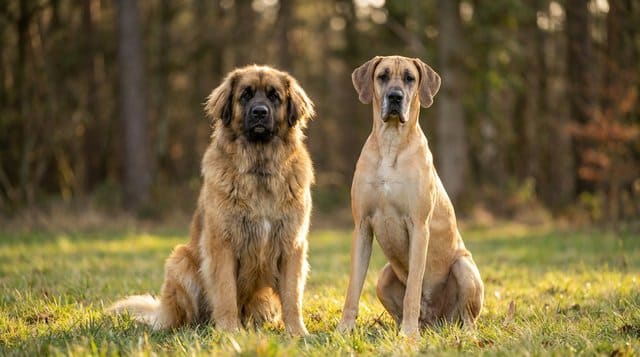
The Leonberger is less well-known than some breeds on this list, but dog lovers who discover them tend to become devoted fans fast. Developed in Germany in the 1800s as a companion for European royalty, the Leonberger was bred to resemble a lion, with a dramatic golden-to-mahogany coat and a distinctive dark mane around the face and chest. They look like something wild. They act like something entirely warm and loving.
Leonbergers are extraordinarily social. They don’t just tolerate people; they genuinely seek out connection with humans and tend to be calm and patient with everyone they meet, from small children to elderly family members. They also tend to get along well with other animals, which makes them a solid choice for multi-pet households.
These dogs need significant daily activity. A Leonberger that doesn’t get enough exercise can become bored and restless. But with proper outlets for their energy, they’re calm and easygoing indoors. They’re also highly trainable, which makes managing a 150-pound dog a lot more practical than you might think.
7. Great Pyrenees: The Patient White Guardian Who Operates on His Own Schedule
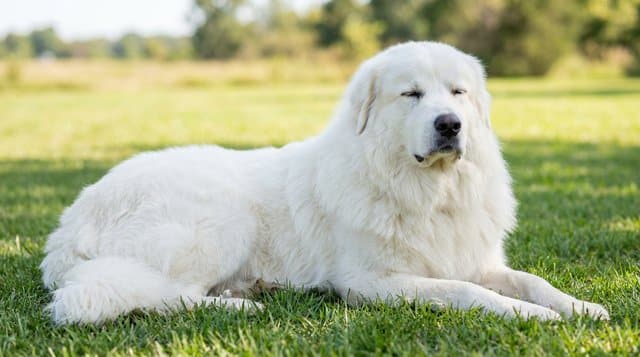
The Great Pyrenees was bred for a very specific job: guarding flocks of sheep in the Pyrenees mountains of France and Spain, often alone, through the night, against wolves and bears. That history explains a lot about their personality. They’re independent, calm, and remarkably confident. They don’t need constant direction because they were designed to make decisions on their own.
For families, this independence shows up as a gentle stubbornness. A Great Pyrenees will follow your lead when it agrees with the plan. When it doesn’t, you might find your very large, very fluffy dog giving you a look that says “I appreciate your input, but I’ve thought about this and I’ll be doing it differently.” Training them requires patience and consistency rather than force.
What makes the Pyr one of the most beloved large dog breeds is that underneath the independence is a genuinely devoted, affectionate companion. They’re calm with children, gentle with other pets, and have a natural instinct to stay close to the people they’re bonded with. Their thick white double coat is gorgeous but needs regular brushing, and they shed heavily. Their calm nature and loyalty earn them a top spot among the most cuddly dog breeds for cozy evenings.
8. Mastiff: The Heavyweight Champion of Calm and Loyalty
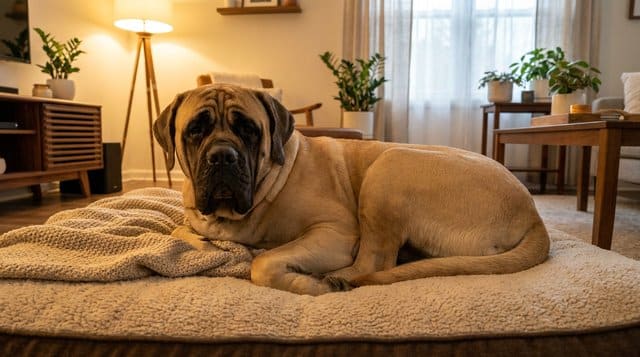
The English Mastiff may be the heaviest dog breed on Earth. Some males tip the scales past 200 pounds. With a broad, wrinkled face and a body that can seem impossibly massive, the Mastiff looks formidable. In practice, they are among the most docile, low-key dogs you can share your home with.
Mastiffs have a long history as guardian dogs, but their approach to that role is less “patrol the perimeter” and more “sit calmly in your presence and make anyone with bad intentions think twice.” They don’t need to prove anything. Their size does the talking. At home with their families, though, these dogs are profoundly gentle, patient with children, and often described as “big softies” by owners who know them well.
The Mastiff’s exercise needs are surprisingly modest. A couple of moderate daily walks keeps them happy and healthy. They’re not built for distance running or high-intensity play. What they need most is the company of their people. Leave a Mastiff alone too often and you’ll see their sensitive side emerge in the form of anxiety or low-level destruction. Keep them close to the family and you get one of the most steadfast, loyal companions in the dog world.
Is a Gentle Giant the Right Dog for Your Life?
Before you fall completely in love with one of these magnificent breeds, here are a few honest things to consider:
- Space matters. Most gentle giants do best in homes with a yard or at least room to stretch out. A studio apartment can work in some cases, but large breeds need space to move comfortably.
- Food costs are real. A dog that weighs 150 pounds eats significantly more than a dog that weighs 20 pounds. Factor the monthly food budget into your planning.
- Vet costs scale with size. Medications, anesthesia for procedures, and specialist care all tend to cost more for larger dogs. Pet insurance is worth researching seriously.
- Lifespan is shorter. It’s one of the harder truths about giant breeds. Most live 7-10 years, some less. The love is enormous; the time feels short.
- Grooming is a commitment. Many of the breeds on this list have significant coat care needs. Budget time (or money for a groomer) accordingly.
- The payoff is extraordinary. If you can accommodate their needs, giant breed dogs offer a kind of companionship that’s hard to match. They’re loyal, loving, and almost universally funny to live with.
Frequently Asked Questions About Large Dog Breeds That Are Gentle Giants
Are gentle giant dog breeds good with kids?
Most of the breeds on this list are known for being patient and gentle with children. Saint Bernards, Newfoundlands, and Bernese Mountain Dogs in particular have strong reputations as family dogs. That said, any dog, regardless of breed, should be supervised around small children, and early socialization matters for every dog’s temperament.
Do large dog breeds need more exercise than smaller dogs?
Not necessarily. Several gentle giants, including the Mastiff and the Great Dane, have moderate exercise needs despite their size. The Great Pyrenees and Irish Wolfhound do benefit from more daily movement. In general, giant breeds need regular activity but not the intense daily output required by high-energy working breeds like Border Collies or Huskies.
What’s the calmest large dog breed?
The Mastiff and the Great Dane consistently rank among the calmest giant breeds in terms of day-to-day energy level. The Irish Wolfhound is also notably quiet and easy-going indoors. Of course, calmness is partly individual personality and partly how a dog is raised, so early training and socialization play a significant role for any breed.
Big Dogs, Even Bigger Hearts: Why Gentle Giants Change You
Living with a large dog breed that’s a gentle giant does something to you. There’s a specific kind of morning, familiar to every giant breed owner, where you wake up to find 130 pounds of dog pressed against your back and a heavy head resting on your feet. It’s genuinely inconvenient and also somehow one of the best feelings in the world.
These breeds don’t just share your home. They fill it in a way that smaller dogs simply can’t match, not because they’re better, but because they’re so physically and emotionally present. They take up real estate on the couch, real estate in your schedule, and an outsized amount of space in your heart.
If you’ve been on the fence about whether a gentle giant is right for your family, the answer is usually yes, provided you’ve got the space, the budget, and the patience for the breed-specific quirks. Whether you lean toward the drool-and-cuddle energy of a Saint Bernard or the quiet dignity of an Irish Wolfhound, there’s a gentle giant out there that fits your life. And once you’ve had one, you’ll wonder how you ever lived without something that size looking at you like you’re the most important person in the room.
If you want to explore more dog breeds across all shapes and sizes, check out the most popular dog breeds according to the AKC for a broader look at what dogs are capturing hearts around the country right now.
