
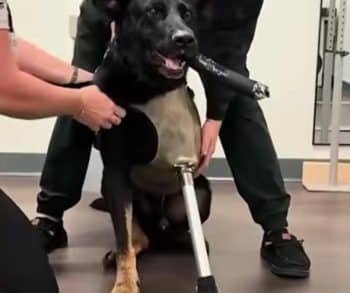
Retired police dog Ace is running, jumping, and enjoying life on four legs again after receiving a custom prosthetic limb following a serious line-of-duty injury. The former Polk County Sheriff’s Office K9 lost his left front leg and shoulder blade after being shot during an encounter with an armed suspect in August, but his recovery has taken an encouraging turn thanks to a team of people determined to help him stay active.
Just three weeks after receiving his new artificial limb, Ace is already moving around without the walking harness he once needed for support. His handler, Deputy Natalie Oestreich, has been beside him throughout his recovery, and now the retired K9 is discovering that his new leg can help him enjoy walks, playtime, and a well-deserved retirement at home.
A Brave Police Dog Begins a New Chapter
Ace’s life changed dramatically in early August when he was injured during an encounter with an armed, wanted suspect. The suspect shot Ace before dying in a shootout with deputies, leaving the police dog with an injury that required extensive veterinary treatment.
Veterinarians ultimately had to amputate Ace’s left front leg and shoulder blade. Following the surgery, the Polk County Sheriff’s Office made the decision to retire him from active duty, allowing him to focus entirely on recovering and adjusting to his new circumstances.
Fortunately, retirement did not mean saying goodbye to the person who had worked alongside him. Deputy Oestreich would continue caring for Ace in her home for the rest of his life, giving him a familiar companion as he learned to navigate daily activities on three legs.
But Oestreich wanted to explore whether there was something more that could help Ace regain some of his former mobility. That search eventually connected her and Ace with specialists who create custom prosthetic devices for animals.
A Special Team Steps Up to Help Ace
Dr. Kerry Jackson of Polk County Animal Control helped arrange the next step by contacting Westcoast Brace and Limb, a company with a St. Petersburg location that specializes in prosthetic and orthotic devices, including custom equipment for animals.
As it turned out, the clinic’s staff members were already familiar with Ace’s story. When they learned that the retired police dog needed help, they offered to create his prosthetic limb at no cost to the department.
Certified prosthetist-orthotist Danielle Tobler explained that the company donated both its time and the work required to produce Ace’s new leg. The fabrication took place at the company’s main laboratory in Tampa, where technicians experienced in animal prosthetics helped bring the device together.
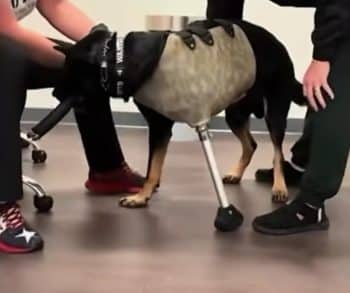
Ace visited the St. Petersburg clinic so practitioners could make a cast of his body and create a device designed specifically for him. A proper fit was especially important because the prosthetic needed to support his movement while accommodating the changes to his front leg and shoulder area.
During his fitting, the team encouraged Ace to move around the clinic and practice transferring weight onto the new limb. Staff members described him as a sweet dog throughout the visit, and they were excited to play a part in helping him recover.
From Needing a Harness to Running Again
Learning to use a prosthetic leg took some adjustment for Ace. In the beginning, he needed a walking harness, with Oestreich holding onto it to provide additional support as he practiced moving with the new device.
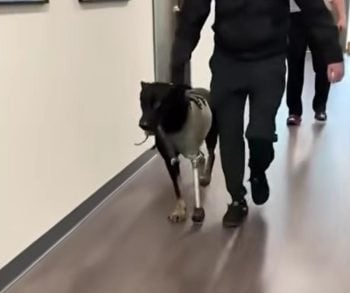
But his progress soon became noticeable. During a follow-up visit with Dr. Jackson, Ace demonstrated just how much his mobility had improved since those first cautious attempts.
“He walks on his own with his leg now,” Jackson said, explaining that Ace no longer needed his handler to hold the harness. The veterinarian added that Ace was now “running and jumping around with the leg.”
For a dog who had recently undergone such a significant amputation, being able to participate in those activities again was an encouraging development. His new prosthetic was helping him move independently during activities that once required additional assistance.
The clinic’s team was so invested in Ace’s progress that staff members even created custom shirts to show their support. Their involvement extended beyond making the device, with plans to continue monitoring how well it worked for him.
A Well-Deserved Retirement Filled With Playtime
Although Ace has made impressive progress, his prosthetic is not intended to be worn throughout the entire day. Instead, Oestreich will put it on him for walks and other activities when the additional support can help him move comfortably.
“It isn’t something he’ll wear all the time. It’s just for those walks and different activities,” Tobler explained. She also said the clinic planned another appointment to check the fit and determine whether any alignment adjustments were necessary.
Those follow-up visits are part of making sure Ace’s new leg continues to work properly as he becomes more familiar with using it. The device has already helped him take an important step forward, but his care team is continuing to pay attention to his changing needs.
Meanwhile, Deputy Oestreich will eventually welcome a new K9 partner for her law enforcement duties. Ace, however, has officially completed his service and will remain with the handler who knows him so well.
For Ace, the next chapter is no longer about responding to calls or carrying out police assignments. With his custom leg available for walks and playtime, he can spend his retirement enjoying the activities he loves, surrounded by the people who helped him get moving again.
 Toledo, United States.